
An adjustable depth therapy pool gives clinicians and athletic trainers more control over how people move, load, and progress in the water.
In rehab and training environments, water depth is not just a design detail. It affects how much body weight a patient or athlete manages during movement. Deeper water provides more buoyancy and support. Shallower water increases loading. That makes depth a useful tool for recovery, reconditioning, and controlled progression.
For athletic facilities, hospitals, outpatient clinics, rehab programs, and senior living facilities, that control matters. People rarely progress in one straight line. Some need a highly supported environment early in recovery. Others are ready for more challenge, more repetition, or more conditioning work. Facilities often serve a diverse patient population, including users of different heights. A therapy pool with adjustable depth helps teams meet users where they are and adapt as they improve.
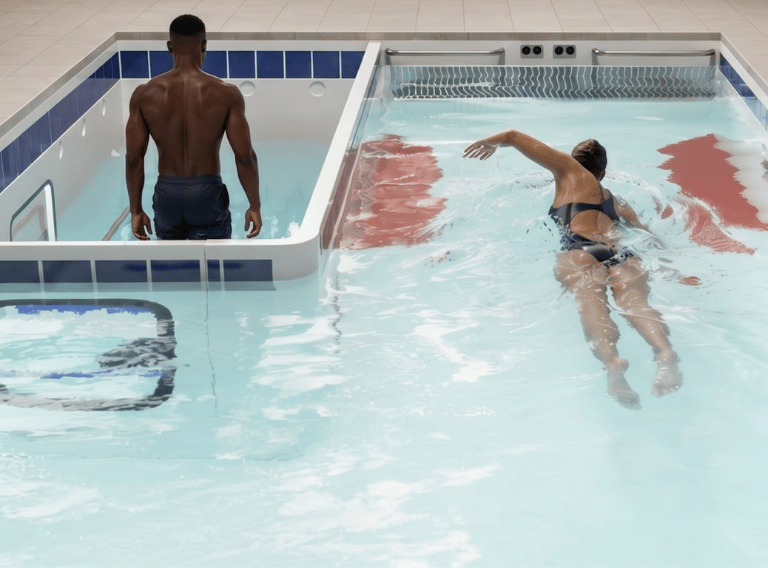
What Adjustable Depth Means in a Therapy Pool
An adjustable depth therapy pool allows the water depth to change in a defined area of the pool. In a clinical or athletic setting, this can help modify how much weight-bearing demand a patient or athlete experiences during an aquatic therapy session.
The concept is simple. When the user is in deeper water, buoyancy helps reduce load. When the depth is lowered, the user carries more of their own weight. That gives clinicians and athletic trainers a practical way to support staged progression without moving immediately from water-based work to full land-based loading.
This can be especially useful for gait training, balance work, lower-extremity strengthening, conditioning, return-to-activity preparation, and return-to-play work. The user can practice movement in a supported hydrotherapy pool environment, then gradually take on more demand as strength, confidence, and tolerance improve.
How Water Depth Changes Weight-Bearing Demand
Variable depth supports staged progression because water depth changes the loading environment.
In early rehab or early reconditioning, a patient or athlete may need more support. Deeper water can make movement feel more manageable, especially when full weight-bearing is not yet appropriate or comfortable. As the user progresses, reducing water depth can increase loading in a controlled way.
| Deeper Water | Shallower Water |
|---|---|
| Provides more buoyancy and body-weight support | Increases weight-bearing demand |
| Helps make early movement, gait work, and balance practice feel more manageable | Helps users build strength, confidence, and tolerance over time |
| Useful when a patient or athlete needs a more supported environment | Useful when a patient or athlete is ready for more challenge |
| Supports lower-load movement during early recovery or reconditioning | Supports progressive loading, conditioning, and return-to-activity work |
Adjustable depth lets teams use the same movement pattern while changing the amount of support and loading around it.
Where Adjustable Depth Adds the Most Clinical Value
Adjustable depth becomes especially valuable when it is used within an underwater treadmill zone.
The treadmill helps create a consistent movement pattern for gait, stride, balance, and conditioning work. Adjustable water depth helps control how much loading the patient or athlete manages during that movement. Together, they support staged weight-bearing progression in a way that is practical for daily therapy and training use.
A patient may begin with more buoyancy during early walking work. As readiness improves, the clinician or athletic trainer can reduce the depth within the treadmill zone to increase weight-bearing demand.
The movement stays familiar. The loading environment changes with the user’s readiness. That can help teams support progression without changing the entire session each time the user improves.
Why Moving the Entire Pool Floor Can Create Bottlenecks
Some systems approach depth progression by adjusting the entire pool floor. In busy rehab and athletic training environments, moving the entire pool floor can create practical constraints.
When the whole floor moves, the entire pool is set to one depth at a time. That can limit flexibility when different users need different treatment environments during the same block of time. One patient may need deeper water for supported movement, while another is ready for shallower water and more loading. An athlete may need treadmill-based progression, while someone else needs a different depth for recovery or therapeutic exercise.
Treating patients of different heights adds another challenge. When the whole pool stays at one depth, clinicians have less flexibility to adjust the water level around each patient’s specific needs.
For many therapy and training programs, the most useful need is controlled progression in the area where staged loading happens most often, the underwater treadmill zone.
Adjustable depth within that defined zone gives clinicians and athletic trainers control where they need it, while the rest of the hydrotherapy pool can remain available for other therapy, movement, recovery, or conditioning work. Instead of requiring the full pool to serve one depth need at a time, the pool can support different activities and depth needs at the same time.
That matters in busy facilities. A therapy pool should support the user, the session, and the schedule. When one area can support adjustable depth while other areas remain usable, the pool becomes more versatile throughout the day.
How Multiple Depth Areas Support Daily Pool Use
A therapy pool is rarely used for one purpose only.
A facility may need early mobility work in one session, progression in another, and general therapy, recovery, or conditioning work at the same time. It may need to support users of different heights, diagnoses, mobility levels, training demands, and goals across the day.
That is why customization matters. A hydrotherapy pool should be planned around the way the facility actually works, not just around a standard depth or single use case. When depth zones are configured around real workflows, the pool can better support the people, programs, and schedules that depend on it.
Variable depth helps make that possible. Adjustable depth in one area can support staged weight-bearing progression, while additional depth zones can support other types of therapy and training. For example, a facility may use 4-foot and 5-foot areas, with the option to add a deeper area when the program requires it.
That gives clinicians and athletic trainers more than one working environment within the same therapy pool. One user can use adjustable depth for treadmill-based progression, while others use separate depth areas for movement, recovery, conditioning, or therapeutic exercise.
For busy rehab and athletic teams, that versatility matters. A therapy pool should help teams support safe movement, guide steady progression, and keep care or training moving throughout the day.
DepthSelect Series for Adjustable Depth Therapy
For facilities looking for a therapy pool with adjustable depth, the SwimEx DepthSelect™ Series introduces adjustable depth within the treadmill zone to support staged weight-bearing progression and better accommodate users of different heights, while preserving paddlewheel current and multiple water depths outside the treadmill area. It does this without the need for full floor movement.
Teams can manage load progression where needed while preserving the broader versatility of the SwimEx pool environment and keeping day-to-day operation practical.
The result is a more versatile therapy environment. Clinicians and athletic trainers can use adjustable depth where controlled progression matters most, while other areas of the pool remain available for different activities and depth needs.
Learn more about DepthSelect Series
A More Versatile Therapy Environment
An adjustable depth therapy pool is not just about changing the water level. It is about giving clinical and athletic teams more ways to match the pool to the user and the program.
For staged progression, variable depth helps modify loading as people move through recovery or reconditioning. Underwater treadmill work helps create a consistent movement environment with controlled weight-bearing demand. For the facility, it can support more flexible use throughout the day.
The value is versatility. A hydrotherapy pool can support controlled progression in one area while remaining useful for other therapy, movement, recovery, or training work at the same time.
When the pool fits the workflow, it becomes easier to use well. And when it is easier to use well, it can better support the steady, repeatable work of rehab and athletic training.